Blog
MRC × C: Mastery, Relationships, Contribution × Commitment
I’ve been FIREd since 2022. In the four years since then I’ve had the freedom to do pretty much anything I choose. I’ve spent three months at a time in Japan, Korea and Malaysia, got deep into Metroidvania games, made YouTube videos, deep-dived into AI for programming and, for a while, even got into the habit of waking up at 5am every morning. I’ve also woken up at 11:30am simply because I felt like it.
There is no boss waiting for me. No commute. No alarm clock unless I decide to set one. I don’t need to think about how many days of annual leave I have left before deciding whether I can go somewhere.
It’s fantastic.
But during this time I’ve met a few other people who have also had the privilege of living without working, and something surprised me. Some of them are now looking for jobs again, not because they need the money, but because they’re bored. They’ve become lazy or slow. The days have started feeling repetitive. There are no particular goals to achieve and no rewards for achieving them.
It got me thinking that perhaps this is something we’re never really taught how to deal with. Most of us simply aren’t accustomed to having unbridled freedom to do absolutely anything we want.
For most of our lives the structure is already there. School tells us where to go, what to learn and whether we’re doing well. Then work takes over. A regular job gives us somewhere to be in the morning, problems to solve, people to interact with, deadlines, challenges, goals and recognition.
Then suddenly you FIRE and all of that disappears.
You’ve achieved the dream: you can do whatever you want.
Which is brilliant, until you wake up on a Tuesday morning and realise you can do absolutely anything you want and have absolutely no idea what to do.
So why not just get a job?
Maybe that’s a perfectly reasonable answer. A regular job gives your life structure, and perhaps the job is tolerable. Maybe it’s even enjoyable. Plenty of people genuinely enjoy their work.
But ultimately it’s a structure somebody else has designed for you. You work during these hours, with these people, solving these problems. You get this many days off and you’re expected to meet these objectives. You take the bad parts of that structure along with the good.
I’ve started wondering whether there’s another possibility.
What if I could build the structure myself?
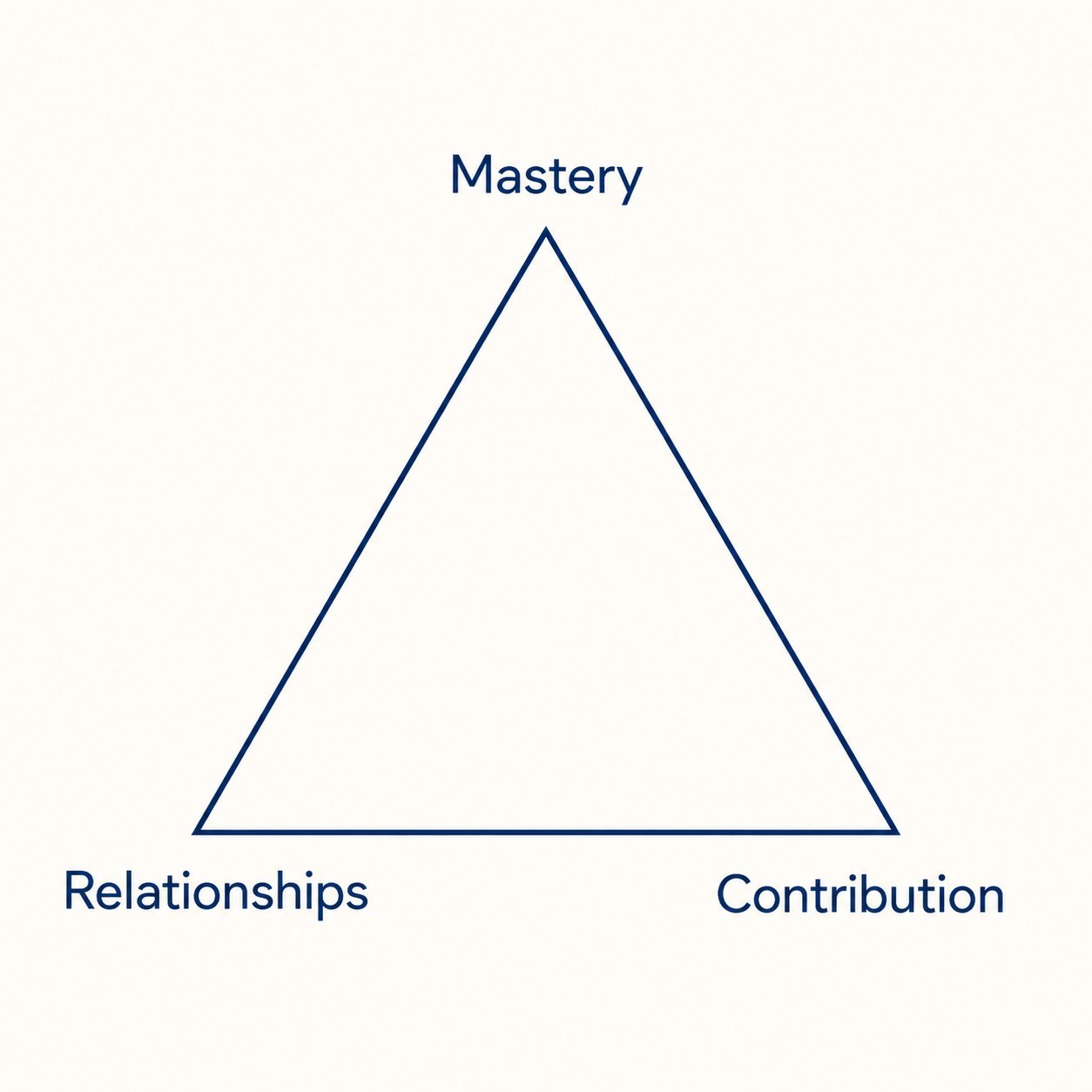
MRC
I’ve been thinking about three areas that seem particularly worth investing my time in: Mastery, Relationships and Contribution.
I don’t mean these as metrics. I’m definitely not interested in creating a spreadsheet where I give myself 73% for Relationships this month and decide my Contribution KPI is underperforming. They’re more like lenses I can occasionally look through when deciding where I want my time and attention to go.
Mastery
What do I want to become good at?
Not because it will improve my CV or because somebody will pay me more, but simply because becoming capable at something is satisfying in itself.
It could be learning guitar, lifting weights, learning Japanese, getting really good at a video game, cooking, drawing or programming. You could build a collection and become ridiculously knowledgeable about it, or learn everything there is to know about some obscure period of history. It almost doesn’t matter what it is.
Find something with depth that you enjoy exploring and get good at it.
Relationships
Who do I want to know, love and share my life with?
Friends, family, partners, communities and new people I haven’t met yet. It’s easy to assume that relationships will somehow maintain themselves while we’re busy doing everything else, but they don’t. They need attention.
Sometimes that means meeting a friend for coffee. Sometimes it means joining a community around something you’re interested in. Sometimes it’s messaging someone you haven’t spoken to for six months, or being there when somebody needs you.
When I previously tried running my own apps business from home, I eventually developed pretty severe cabin fever. I was spending a lot of time alone and wasn’t putting enough effort into seeing other people regularly. Eventually I started attending a weekly software meetup and making more of an effort to stay in touch with friends. It helped enormously.
We’re social animals. Having the freedom to spend all of our time alone doesn’t necessarily mean it’s good for us.
Contribution
What do I want to give, create or do that matters beyond myself?
This doesn’t have to mean solving world hunger. It could mean mentoring somebody, volunteering, helping a friend, contributing to open source, organising a meetup or teaching somebody something you know.
Or it could mean making something.
I make apps for Android and iPhone. Someone I’ve never met can download something I’ve made and find it useful. There’s something enormously satisfying about that.
I think of Contribution simply as taking some part of what I have — my knowledge, skills, time, attention or creativity — and allowing it to flow outward.
The interesting part is where they overlap
These aren’t really three completely separate boxes. In fact, I suspect some of the richest things we can do sit somewhere in the middle of them.
Suppose I decide to learn guitar. That’s Mastery. Eventually I start playing with other musicians and make some good friends. That’s Relationships. Perhaps eventually we play a gig that other people enjoy. That’s Contribution.
Or perhaps I become knowledgeable about something, meet other people who are interested in it and eventually help newcomers learn about it. One pursuit has moved through all three parts of the triangle.
This all sounds lovely intellectually, of course. I can decide I want deep friendships. I can decide I want to be good at guitar. I can decide I want to make things other people find useful.
And then tomorrow morning I can wake up and play video games for eight hours instead.
Something is missing.
Commitment
This is the multiplier.
MRC × C
Commitment is what turns the nice ideas into something real. Without commitment, Mastery can remain dabbling. Relationships can remain acquaintances and good intentions. Contribution can remain something we’re definitely going to get around to one day.
Commitment means deciding that something matters enough that I’m going to keep showing up for it.
Take learning guitar. The first few lessons might be exciting because everything is new and you’re imagining where it could lead. Then comes practice. Five minutes into a thirty-minute session your mind starts wandering. That particular riff makes no sense. Your fingers aren’t doing what you tell them to do and you don’t seem to be getting any better.
But you keep going, and then one day, somehow, you can play it.
When we imagine mastery we tend to imagine the exciting bit at the end. Standing on stage jamming in front of a cheering crowd, or looking at the Tekken rankings and discovering that you’re the undisputed best player in the world. What we don’t imagine are the enormous number of completely ordinary Tuesdays that got you there.
Relationships work in much the same way. It’s easy to say that friendship and community are important. Actually having those things requires showing up. People are busy. You’re busy. Someone has to send the message, organise the dinner or travel across town. Sometimes you go to the weekly meetup even though you’d quite like to stay home.
A friendship of twenty years isn’t necessarily twenty consecutive years in which that person was the most exciting possible person you could have spent your evening with. Part of its value comes from the fact that you both kept showing up.
Contribution needs the same thing. I regularly encounter problems with the apps I make. App-store submissions fail, advertising systems break, operating systems change, users find bugs and feedback reveals poor experiences that need fixing. Something that worked perfectly six months ago suddenly needs updating.
These maintenance tasks are rarely as exciting as having the original idea and creating something new. But if I want the thing I’ve made to continue being useful to other people, I have to do them. I choose to continue, and the gratification I get from knowing that something I’ve created is being used by other people makes the boring parts worthwhile.
So I’ve escaped the cage… and built another one
There’s an obvious criticism of all this.
I escaped the structure of work so that I could be free, and now I’m proposing goals, routines, practice, obligations, communities, maintenance tasks and a daily To Do list.
Congratulations. I’ve recreated work.
I’ve built myself another cage.
Actually, I think the cage analogy is useful. A regular job is a cage of sorts. It gives your life structure, which can be useful, but that structure can also restrict your life and happiness. You need to be somewhere at 9am because somebody else decided you should be. You might want to spend three months in Japan, but your annual leave allowance says no.
Financial independence opens the cage door. You walk outside and suddenly you can go anywhere.
That’s an incredible feeling.
But eventually you might discover that endless open space has its own problem: there is no direction.
MRC × C does introduce constraints again, but there’s a crucial difference. I designed them.
I can move the bars. I can remove them. I can add new ones. If something stops serving me, I can reconsider it. Most importantly, the structure exists to serve the life I’ve chosen rather than the objectives of a company.
I’m voluntarily giving up small pieces of freedom in exchange for things I’ve decided matter more.
Maybe maximum freedom isn’t the goal
This is the part I’ve found most interesting.
For years I thought of freedom almost entirely as something to maximise. Not needing a job gives me more freedom. Not owning lots of things gives me more freedom. Being able to travel gives me more freedom. Keeping my time flexible gives me more freedom.
When you don’t have enough freedom, acquiring more of it is incredibly valuable.
But perhaps freedom has diminishing returns.
Almost everything that becomes deeply valuable eventually asks you to give up some optionality. A friendship means sometimes arranging your day around somebody else. A community means showing up. Mastery means practising when you could be doing something easier. Contribution means accepting some responsibility for something beyond yourself.
The more committed I become to something, the less free I am to simply walk away from it.
But perhaps that’s not a flaw.
Perhaps that’s the point.
I’ve spent a large part of my adult life thinking about cost versus value. I became pretty good at finding ways to get the experience or quality of life I wanted without spending unnecessarily. Being careful about cost gave me more value, and eventually having enough value gave me freedom.
Cost → Value → Freedom.
For a long time I implicitly assumed that Freedom was the destination.
Now I’m wondering whether the sequence actually continues:
Cost → Value → Freedom → Commitment.
Perhaps one of the things freedom is for is deciding what is valuable enough to voluntarily give some of that freedom back.
But not everything needs to have a purpose
There’s a danger here too, particularly for someone like me who is naturally inclined towards optimisation.
I don’t want MRC × C to become another optimisation system. I don’t want to wake up every morning asking whether today’s activities are sufficiently contributing to Mastery, Relationships and Contribution. I certainly don’t want to start assigning everything a category and measuring whether I’ve achieved the optimal M:R:C ratio this week.
That sounds exhausting.
Sometimes I want to go to Kyoto for the weekend and wander around temples because wandering around temples is nice. I don’t need to master Buddhism or Japanese architecture while I’m there. I don’t need to make friends with three people at Kiyomizu-dera and I don’t need to produce a YouTube video afterwards to contribute my newfound temple knowledge to the world.
I can just wander around Kyoto.
Sometimes I want to meet a friend for coffee simply because I like my friend. Sometimes I want to spend the entire day in my pajamas playing video games, not because I’m mastering the game, preparing for a tournament or participating in a gaming community, but because I want to be lazy and play video games.
That’s allowed.
In fact, that’s part of the freedom I wanted in the first place.
MRC × C isn’t supposed to consume my life or justify how I spend every hour of it. It’s there for the things I’ve decided I want to build in my life.
My own structure
I have a daily To Do app that reminds me about some of the small things I’ve chosen to do regularly: exercise, stretching, working on particular projects and generally keeping things moving.
There are plenty of days when I can’t be bothered. There are days when I don’t do them. There is no boss who’s going to call me into a meeting because I neglected my squats.
But these are things I chose.
That’s the important distinction.
I’m not trying to replace employment with a relentless personal-productivity regime. I’m trying to give enough structure to the things I care about that they have a chance to become real. The daily actions themselves can be mundane, but over time they move me towards things that I’ve consciously decided I want in my life.
Mastery. Relationships. Contribution.
Multiplied by Commitment.
Ready to give MRC × C a try?
You don’t need to be FIREd or have complete control over your schedule for MRC × C to be useful. Maybe life is generally fine, but you find yourself feeling bored or unfulfilled after work or at the weekends, with a nagging sense that something is missing. If so, try looking at your life through these three lenses. Is there something you’d love to become genuinely good at? Are there relationships you’d like to deepen or new ones you’d like to build? Is there some way you could use your time, skills or knowledge to contribute to something beyond yourself?
Then think about Commitment. Pick something that matters and give it a real place in your life — even a small one. Not every hour needs to be productive and not everything you enjoy needs a greater purpose, but the things that genuinely matter to you may need some deliberate time and attention if they’re ever going to grow.
MRC × C isn’t intended to tell you how to spend your life. It’s simply a lens for noticing what might be missing, deciding what deserves more of your attention, and then showing up often enough to see where it leads.